
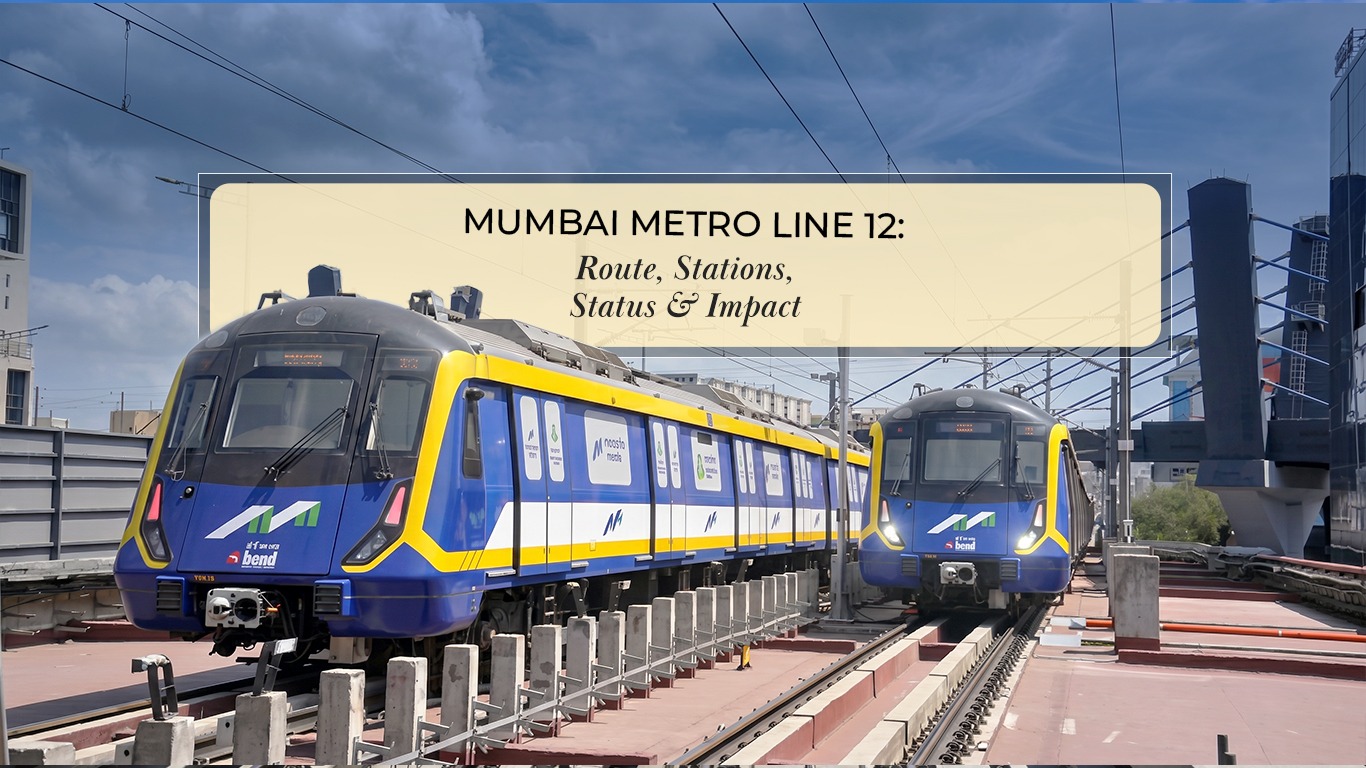
Mumbai Metro Line 12 is one of the most important upcoming metro corridors in the eastern Mumbai Metropolitan Region. Running through the fast-growing Kalyan–Dombivli–Taloja belt, this fully elevated Orange Line corridor promises to cut a daily commute that once took over an hour down to roughly half an hour. For families and investors looking at homes along the Kalyan–Shil and Dombivli growth corridor, Metro Line 12 is the kind of connectivity catalyst that reshapes property demand. This guide covers the route, station list, cost, current status, completion timeline and — most importantly — the real estate impact of Metro Line 12.
Quick Facts:
- Length: 23.57 km
- Stations: 19
- Type: Fully elevated
- Route: Kalyan (APMC) to Taloja (Amandoot)
- Implementing Agency: MMRDA
- Estimated Cost: ₹5,865 crore
- Target Completion: Phased completion towards 2027
What Is Mumbai Metro Line 12?
Metro Line 12 is an elevated mass rapid transit corridor being built by the Mumbai Metropolitan Region Development Authority (MMRDA) as part of Mumbai Metro’s Orange Line. It is conceived as an extension of Metro Line 5 (Thane–Bhiwandi–Kalyan), carrying the network onward from Kalyan to Taloja in Navi Mumbai.
The line’s core purpose is to decongest the choked road network between Kalyan, Dombivli and Navi Mumbai, and to bring rail-based connectivity to a corridor that is rapidly transforming from semi-industrial land into residential and commercial townships.
Metro Line 12 Key Details at a Glance
Parameter | Detail |
|---|---|
Corridor | Kalyan (APMC) to Taloja (Amandoot) |
Line / Colour | Orange Line (extension of Metro Line 5) |
Length | ~23.57 km (fully elevated) |
Number of stations | 19 (all elevated) |
Depot | Nilje (approx. 31 hectares) |
Projected daily ridership (2031) | ~2.62 lakh passengers |
Figures are based on the latest MMRDA project disclosures
Metro Line 12 Route and Stations
Metro Line 12 begins at Kalyan and travels through the heart of the Kalyan–Dombivli–Taloja growth belt before terminating near Taloja in Navi Mumbai. The alignment threads through a mix of established residential pockets, MIDC industrial zones and emerging township land.
Major Stations on Metro Line 12
The corridor’s proposed 19 elevated stations include key stops such as: Kalyan APMC > Ganesh Nagar (Kalyan) > Pisavali Gaon > Golavali > Dombivli MIDC > Sagaon > Sonarpada > Manpada (Dombivli East) > Hedutane > Kolegaon > Nilje Gaon > Vadavali > Bale > Waklan > Turbhe > Pisarve (Depot) > Amandoot (Taloja).
This places residential and industrial hubs like Dombivli MIDC, Manpada, Shilphata, Turbhe and Taloja directly on the metro map for the first time. Metro Line 12’s value lies in its interchange points, which plug the Kalyan–Taloja belt into the larger MMR transit grid:
- Kalyan — interchange with Metro Line 5 (Thane–Bhiwandi–Kalyan), linking onward toward Thane.
- Hedutane — interchange with the proposed Metro Line 14 (Vikhroli–Badlapur).
- Amandoot (Taloja) — interchange with Navi Mumbai Metro Line 1 (Belapur–Pendhar/Khandeshwar).
In practical terms, a commuter in Dombivli will be able to reach Thane via Line 5 or move into Navi Mumbai via the Navi Mumbai Metro — without battling the Kalyan–Shilphata road bottleneck.
Travel Time and Commuter Benefit
The important benefit of Metro Line 12 is time. Today, the road journey between Kalyan and Taloja can take well over an hour during peak traffic. Once operational, the metro is expected to cover the corridor in roughly 25–30 minutes, with MMRDA projecting travel-time savings of 50% to 75% depending on road conditions.
Beyond speed, the line is expected to:
- A large number of private vehicles off the Kalyan–Shil and Shilphata roads each day.
- Offer reliable, weather-proof connectivity for the large workforce commuting to MIDC and Taloja industrial belts.
- Strengthen last-mile access for residents of Dombivli East, Manpada and the surrounding villages.
Metro Line 12’s Impact on Real Estate
For homebuyers and investors, this is where Metro Line 12 becomes genuinely exciting. Metro connectivity has repeatedly proven to be one of the strongest drivers of residential demand and price appreciation in the MMR — and Line 12 runs straight through one of the region’s most affordable, high-potential corridors.
- Improved connectivity lifts liveability. Locations like Dombivli, Manpada and the Kalyan–Shil corridor become far more attractive once a 30-minute metro ride replaces an hour-plus road commute.
- Transit-oriented development (TOD). Metro corridors typically concentrate housing, retail, offices and services around stations, creating self-sustaining micro-markets.
- Affordability with upside. Compared with central Mumbai and even parts of Thane, the Kalyan–Dombivli–Taloja belt still offers entry pricing — with a clear infrastructure-led growth story.
- Rental and resale demand. Proximity to a metro station is a premium feature that has historically supported rental demand and long-term capital appreciation in many MMR micro-markets.
What This Means for the Thane–Dombivli Belt
Through its interchange with Metro Line 5 at Kalyan, Metro Line 12 effectively links the Kalyan–Dombivli–Taloja corridor to Thane — a market where Ashar Group has built a long-standing reputation for quality residential, retail and commercial developments. As the Orange Line knits these markets together, key parts of eastern MMR stretch — from Thane through Kalwa, Mulund, Ghatkopar and onward to the Dombivli–Taloja belt — stands to benefit from compounding connectivity.
For buyers, the takeaway is simple: infrastructure of this scale rarely stays a secret for long. Property along and around upcoming metro corridors tends to appreciate well before the first train runs.
Frequently Asked Questions About Metro Line 12
What is the route of Mumbai Metro Line 12?
Metro Line 12 runs from Kalyan (APMC) to Taloja (Amandoot) in Navi Mumbai, passing through key areas including Dombivli MIDC, Manpada, Hedutane, Nilje, Turbhe and Pisarve. It is part of Mumbai Metro’s Orange Line.
How many stations are there on Metro Line 12?
How long is Metro Line 12 and how much does it cost?
When will Metro Line 12 be completed?
Which areas will benefit most from Metro Line 12?
Is property near Metro Line 12 a good investment?
Locations along upcoming metro corridors historically see strong demand and appreciation, especially affordable, high-growth belts like Kalyan–Dombivli–Taloja. Improved connectivity, transit-oriented development and entry-level pricing make this corridor attractive for both end-users and investors.
Is Mumbai Metro Line 12 fully elevated?
Yes. Mumbai Metro Line 12 is planned as a fully elevated corridor comprising 19 elevated stations between Kalyan (APMC) and Taloja (Amandoot).
Which metro lines connect with Metro Line 12?
Metro Line 12 will connect with:
- Metro Line 5
- Proposed Metro Line 14
- Navi Mumbai Metro Line 1
Conclusion
Mumbai Metro Line 12 is more than a transit project — it is a long-term growth engine for the eastern MMR. By linking Kalyan and Dombivli to Navi Mumbai, and connecting onward to Thane via Metro Line 5, the Orange Line is set to redefine how this corridor lives, works and commutes. For homebuyers and investors who value connectivity, convenience and capital appreciation, the regions around Metro Line 12 deserve a close look.
At Ashar Group, we have spent years building landmark residential, retail and commercial spaces across Thane and the wider Mumbai Metropolitan Region — always at the choicest, well-connected locations. As MMR’s metro network expands, our commitment remains the same: delivering homes and spaces where infrastructure, lifestyle and lasting value come together.
To explore Ashar Group’s residential and commercial projects across Thane and the MMR, get in touch with our team.