
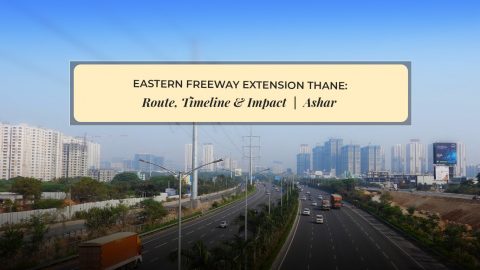
Eastern Freeway Extension to Thane: The Signal-Free Corridor Set to Redraw the Mumbai Commute
The long-awaited vision of traveling from South Mumbai to Thane in just half an hour is fast becoming an exciting, seamless reality for everyday commuters. The Mumbai Metropolitan Region Development Authority (MMRDA) has begun construction of the Eastern Freeway extension to Thane — an elevated stretch that will finally connect the existing Eastern Freeway all the way to the heart of Thane. For homebuyers, commuters and investors watching the Thane market, it is one of the most consequential infrastructure moves of the decade.
This guide breaks down exactly what the project is, the route it follows, how much time it will save, where construction stands today, and — most importantly — what it means for property along the corridor.
Quick Facts: Eastern Freeway Extension to Thane
Parameter | Detail |
|---|---|
Total Length | 13.9 km |
Lanes | 6 (access-controlled) |
Project Cost | ₹2,682 crore |
Design | Signal-free corridor |
Route | CSMT → Chheda Nagar → Vikhroli → Mulund → Anand Nagar, Thane |
Travel Time (Today) | Typical travel: 40–60 minutes (can exceed an hour during peak traffic) |
Travel Time (After Completion) | 25–30 minutes |
Construction Status | Underway — excavation, foundations, pier casting in progress |
Major Milestone | 160-tonne steel trusses successfully installed |
Execution Period | 4 years (including design & construction) |
Current Status | Progressing; land acquisition completed |
Thane Micro-Markets Benefiting | Majiwada, Manpada, Kapurbawdi, Kolshet, Ghodbunder |
Eastern Freeway Extension to Thane: Route, Timeline & Impact
The Eastern Freeway extension is a northward continuation of Mumbai’s existing 16.8 km Eastern Freeway, which today links Chhatrapati Shivaji Maharaj Terminus (CSMT) in South Mumbai to Chheda Nagar in Ghatkopar. Until now, that fast, signal-free run simply ended at Ghatkopar, dumping traffic back onto the congested Eastern Express Highway for the remaining journey to Thane.
The extension closes that gap. It is a 13.9 km fully elevated, six-lane corridor built directly above the Eastern Express Highway, carrying long distance traffic over the surface-level chokepoints rather than through them. Once complete, a driver will be able to travel from CSMT to Anand Nagar in Thane on a continuous, uninterrupted, signal-free road.

The Route: From Chheda Nagar, Ghatkopar to Anand Nagar, Thane
The corridor begins near Chheda Nagar in Ghatkopar — where the current Eastern Freeway ends — and threads north above the Eastern Express Highway, passing the Ramabai Nagar, Vikhroli, Kanjurmarg and Mulund belts before terminating at Anand Nagar on the Thane side. Because the entire alignment sits on an elevated deck, local surface traffic and the freeway’s long-distance traffic no longer compete for the same road space.
Entry and Exit Points
To keep the corridor useful for shorter trips and not just end-to-end travel, MMRDA has planned dedicated entry and exit ramps at key junctions. Two-lane ramps are proposed at Vikhroli Junction, Airoli Junction and Mulund Check Naka, allowing commuters to hop on or off closer to their destination instead of driving the full length. This ramp network is what makes the extension valuable for daily intra-region commuting, not merely inter-city trips.
Connectivity with Mumbai Metro, Eastern Express Highway & Thane Road Network
At the Thane end, the extension is designed to tie into the proposed Anand Nagar–Saket elevated corridor near Mulund, strengthening the north-south spine of the region. Read alongside the Metro network, the Thane–Borivali twin tunnel and other planned links, the freeway extension becomes one thread in an increasingly dense connectivity grid rather than a standalone road.
How Much Time Will the Eastern Freeway Extension Save?
The headline number is the one that has captured attention: the MMRDA expects the corridor to reduce travel time between South Mumbai and Thane to roughly 25 to 30 minutes. Today, the same journey on the surface Eastern Express Highway can take well over an hour during peak periods, thanks to signals, merging traffic and recurring congestion at Vikhroli and Mulund.
By elevating through-traffic above these pressure points, the extension does two things at once: it speeds up long-distance journeys, and it relieves the surface highway for local movement. Together both effects increase the value of living or working anywhere along the corridor.
Construction Progress and Timeline
As of mid 2026,MMRDA has commenced foundational work, pier construction and structural steel installation are progressing across multiple stretches of the alignment. In a widely reported engineering milestone, the authority erected 160-tonne steel trusses over the live Eastern Express Highway in a tightly managed window of about four hours — a signal that the technically demanding, over-traffic construction is moving forward.
The project is being executed over an overall span of roughly four years — an initial phase for design and clearances followed by about 36 months of civil construction. Land acquisition along the route has been addressed, including the rehabilitation of affected slum units in the Ramabai Nagar stretch. As with any elevated highway of this scale, some roadside trees along the Eastern Express Highway are affected and are being managed as part of the project’s clearances.
Why the Eastern Freeway Extension Matters for Thane Real Estate
Infrastructure that shrinks commute time reliably reshapes property demand — and this corridor targets one of the most valued journeys in the region: Thane to South Mumbai’s business districts. When a 60-plus-minute commute becomes a predictable half-hour drive, Thane becomes materially more attractive to buyers who work in Lower Parel, BKC-adjacent areas and South Mumbai but want more space and better value for money.
Micro-Markets Set to Benefit
The clearest beneficiaries are the established residential belts of Thane West — the Majiwada, Manpada and Kapurbawdi clusters, the Kolshet–Balkum corridor, and the Ghodbunder Road stretch. These are precisely the areas that feed onto the Eastern Express Highway, so faster, signal-free access to Mumbai directly improves their liveability equation. Improved connectivity is generally associated with stronger residential demand and long-term price appreciation, although actual price movements depend on market conditions.
A Multi-Modal Connectivity Grid
The freeway extension does not act alone. It layers on top of Thane’s expanding rail and metro network — including the lines covered in our guides to the Thane Metro line and Mumbai Metro Line 5 — plus planned road links like the Thane–Borivali tunnel. For a homebuyer, this multi-modal density is the real story: multiple independent ways to reach the rest of the metropolitan region, which is what sustains long-term property value.
Living Along the Growth Corridor: Ashar Group in Thane
Several Ashar Group developments are located close to corridors expected to benefit from the proposed connectivity improvements, including Ashar Pulse, Ashar Merac and Ashar Arize.
Ashar Pulse at Majiwada Junction, Thane West — a location that plugs directly into the Eastern Express Highway and, in turn, the freeway extension.
Ashar Merac at Shree Nagar and Ashar Arize at Kalwa — residences positioned to benefit from improved north-south access.
On the commercial side, Ashar Millennia, Ashar Bellezza and the Ashar IT Park strengthen Thane’s standing as a workplace destination, not just a residential suburb.
Frequently Asked Questions
What is the Eastern Freeway extension to Thane?
How long will it take to travel from South Mumbai to Thane?
Where does the Eastern Freeway extension start and end?
When will the Eastern Freeway extension be completed?
Which Thane areas benefit most from the extension?
Is the Eastern Freeway Extension different from the Eastern Express Highway?
Will the Eastern Freeway Extension reduce traffic on the Eastern Express Highway?
Which authority is constructing the Eastern Freeway Extension?
The Road Ahead
The Eastern Freeway extension to Thane is more than a new highway — it is a re-rating of what it means to live in Thane and work in Mumbai. By turning an unpredictable, hour-long slog into a reliable half-hour drive, it removes the single biggest friction point for the region’s commuters and, in doing so, strengthens the long-term case for property along the corridor. As construction progresses, improved road connectivity is expected to strengthen Thane’s appeal for both homebuyers and businesses. Buyers evaluating long-term value may wish to consider locations that benefit from multiple transport projects rather than relying on a single infrastructure upgrade.
Infrastructure information in this article has been compiled from official MMRDA project documents, government announcements and leading national publications. Timelines may change as construction progresses.
Sources
- MMRDA – Construction of Elevated Eastern Freeway Extension (Chheda Nagar, Ghatkopar to Anand Nagar, Thane)
- MMRDA – Details of Project (node 5796)
- Financial Express – South Mumbai to Thane in just 30 minutes: MMRDA achieves major breakthrough on Eastern Freeway Extension
- Times of India – Mumbai’s Rs 2,682 crore Eastern Freeway Extension promises signal-free ride from South Mumbai to Thane
- CREDAI MCHI Thane – Transforming Thane: The Eastern Freeway Extension
- Free Press Journal – MMRDA begins work on 12.9-km signal-free corridor from Ghatkopar to Thane
- Construction World – MMRDA begins Rs 26.8 billion Eastern Freeway Extension